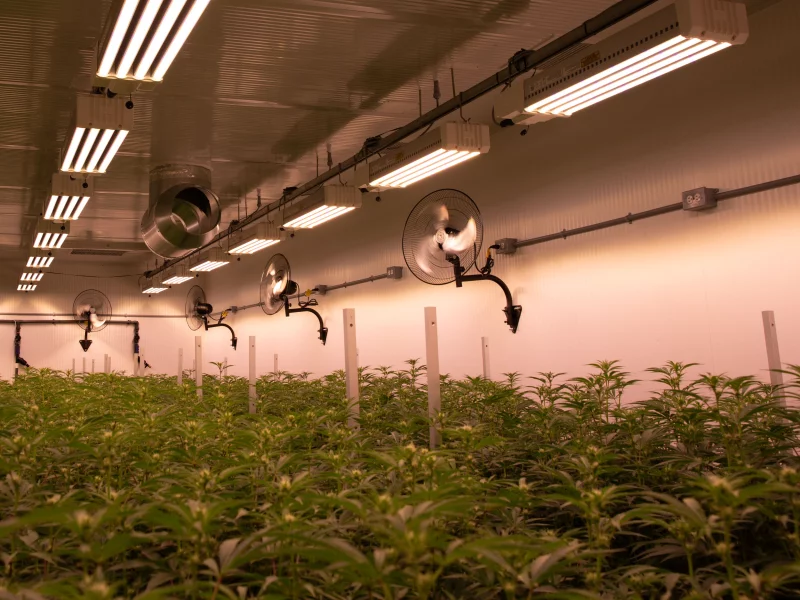
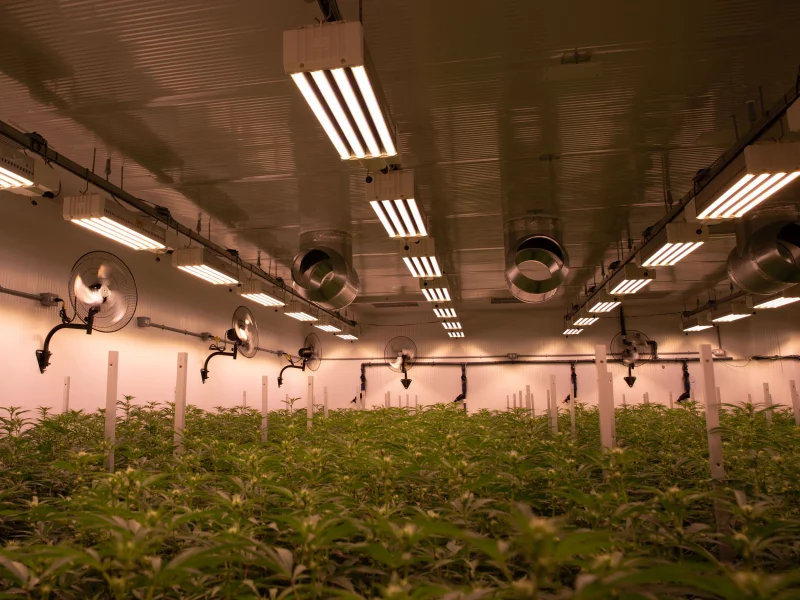
For as long as cannabis has been grown indoors under high-pressure sodium lamps, the lamp has done two jobs at once. Every HPS fixture sends a large share of its energy down onto the canopy as infrared heat, keeping the leaves warmer than the air around them, and over the years that heat became part of the room, built into the setpoints and crop schedules growers rely on. Once a facility replaces those HPS fixtures with LED, far less heat comes down onto the canopy, and the warmth the crop used to get from the lamp has to come from the air. “Not increasing the air temperature is the most common mistake. You see that plant development goes slower, and you may need extra time to finish your product” says Mexx Holweg, Head of Crop Science & Agronomy at Dutch Lighting Innovations (DLI).
DLI has seen that transition from both sides. The company has spent 15 years producing lights for horticulture, mostly for large-scale conventional crops such as tomatoes, cucumber and ornamentals, and it supplies cannabis growers as well. “The main thing that sets us apart is that we apply our technology from conventional horticulture to cannabis,” Mexx says.
For most of those years, cannabis growers worked under HPS, and DLI supplied them. The company still produces HPS fixtures and sells them to a large part of the market, especially in the US, and Mexx still considers the HPS spectrum a very good one. As energy costs rose and growers asked for more control over their cultivation, DLI started developing LED as well, and it now offers a top- and undercanopy light for greenhouses and indoor rooms, and linear fixtures for vertical farms. “We still believe top light is the most effective way of delivering light to the crop, but depending on the cultivation system, there are benefits in lighting under the canopy as well,” he says.
Differences in strategy
Mexx sees growers switch to LED for more control and more production from the same wattage. DLI offers a one-to-one replacement for HPS, but a grower can also start by replacing half of the HPS fixtures with LED, so the transition happens gradually and the team learns how to grow under fixtures that give off less radiative heat. “I think the main thing for growers to consider during an LED switch is the cultivars. Cannabis responds very differently. A cultivar that grows one way under HPS can grow more compact under LED, and its development can also go slower if other environmental settings are not adjusted,” he says.
The difference comes from the spectrum. “Under HPS you have a higher fraction of far-red to red, and almost no blue light compared to a white light spectrum, so you see more stretching, and in general that gives you a more open plant canopy. Under conventional white LED you see more branching and more compact growth,” Mexx explains. Growers have to adapt the plant architecture they aim for to the light the plants receive. “Instead of keeping four main branches, as you would under HPS, you may keep three under LED to adjust for the more compact growth,” he says.
Swapping HPS for LED at the same wattage also brings about 1.5 times more light, and the rest of the room has to keep up. More light calls for more CO2, and to take up that CO2 faster the plants need a faster metabolism and a higher temperature, which in turn means more transpiration, more irrigation and a higher HVAC capacity, Mexx explains. “Everything in the room is connected, so the starting point is the grower’s main goal for the transition.”
More light is not automatically an improvement either. “If you increase the light intensity, most of the extra yield comes from a higher volume of flowers and bigger colas, and that means more humidity in the cola and a higher risk of botrytis. If you can’t manage the higher light intensity, it’s not beneficial,” Mexx points out.
The lost heat is also where much of the hesitation lies, as growers across horticulture fear that LED will force them to spend more energy on heating rooms that HPS used to keep warm. Mexx points to a study at Wageningen University that compared growers using HPS with growers using LED and a separate heat source, and found that splitting the two, with electricity for the LEDs and gas for heating, was the most efficient way to use energy.
Spectrum and UV
The spectrum itself is an ongoing research question for DLI, which studies cannabis lighting at the Vertify research facility and with universities, and Mexx brings a PhD in plant photobiology to that work. “When we set the spectrum of our main top light, we weigh the cost of producing the fixture and with it the grower’s initial investment, LEDs that last a long time, a high conversion of energy into photons, a light output that stays the same after years of use, and how the crop responds,” Mexx explains. DLI’s Nova fixture comes in two spectra. “The veg version carries more relatively more blue to encourage branching, and the flower version increases red, which the plant absorbs more easily to drive photosynthesis,” he points out.
In conventional horticulture, growers commonly control blue, red, far-red and white channels independently and shift the balance with the cultivation goal and energy prices. With a tunable four-channel fixture, Mexx explains, an indoor grower can raise far-red while the plants are young to expand leaf area, depending on the cultivar, and adjust again in flower. “If you have a cultivar that is prone to white tipping, it comes down to the amount of red photons during the day. If the next cultivar isn’t susceptible to white tipping, we can increase the red. That’s when tuning comes into play,” he says. Tuning takes both the technology and knowledge of plant physiology, and it can be complex for growers who are not familiar with LEDs. “It’s about giving growers technology that can assist them step by step,” Mexx says.
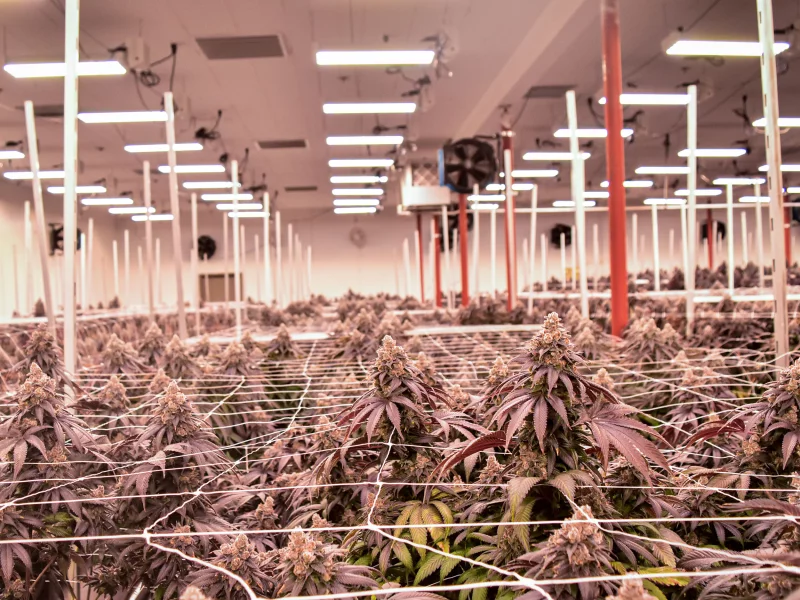
That is also why DLI wants data behind the white tipping debate. In a greenhouse compartment at Vertify, the company compares HPS with its high-efficiency horticultural LED spectrum on yield, quality and energy efficiency. Its very efficient red-heavy spectrum produced some white tipping, and Mexx wants to know whether a higher yield per square meter with some white tipping is really a bad result when energy efficiency and total yield might increase. DLI is running the same comparison between standard HPS and LED, and the results should be available in a couple of months.
UV is a different story. DLI supplies UV through a UV high-intensity-discharge lamp, like and HPS, and Mexx considers UV much more complex to research than other wavelengths, since its effect depends on the mix of UV-A, UV-B and UV-C, on the intensity and on the moment of application. UV-C is useless for the crop and only good for disinfection. “With UV you try to induce a stress response, where the stressor doesn’t cause harm but increases cannabinoid and terpenoid concentrations,” he says.
At Wageningen, DLI studies how UV interacts with the top light. Plants grown under high light intensity are harder to stress with UV, and require a higher UV dose, while UV applied at a lower light intensity makes cannabinoids and terpenoids accumulate faster and the crop ripen quicker, Mexx explains. Plants grown without any UV are very sensitive to it, and even a fraction of the UV found in sunlight raises cannabinoid and terpenoid levels, he adds.
“If you look for the right UV dose, I’d look at nature: what is available in sunlight under which cannabis evolved for ages, what do we want to replicate, what is roughly the UV to PAR ratio, and how do we replicate that in an UV-absent environment,” Mexx says. Scientific papers differ widely in the amount of UV they apply, most of those that call UV harmful used only UV-C, and a trial on a single cultivar does not allow a general conclusion, he points out. UV-B damages cells but also triggers the strongest response, and in other crops growers apply it together with UV-A. “The closer you get to the blue spectrum, the more the effect changes. It’s very wavelength-dependent, and UV is quite unique in this regard,” Mexx says.
A grower’s room
Before any fixture goes up, DLI works out how the light will reach the canopy, starting from the grower’s room: how much space there is between the top light and the canopy, how dense the planting is and how tall the plants grow, from which the company calculates the light intensity at different heights of the canopy. “In low rooms, where there is not enough height for standard lenses, wide lenses let the fixtures hang closer to the plants, scattering the light inside the fixture before it leaves at a wider angle” Mexx explains. Where height allows, DLI prefers deep-focus lenses on its top lights, and for vertical farms its linear fixtures spread the wattage over a long distance at a lower output, so they can sit close to crops such as lettuce and herbs.
Let's talk about your harvest?
We are happy to talk it through. Just reach out with any questions.